.png?width=200&height=111&name=RA%20Logo%20450%20x%20250%20(4).png)
.png?width=450&height=250&name=RA%20Logo%20450%20x%20250%20(4).png)
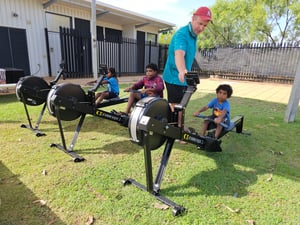
Rowing Australia (RA) has delivered a multi-sport experience to one of the country’s most remote communities, partnering with Paddle Australia (PA) and Surf Life Saving Australia (SLSA) to run a two-day Sporting Schools program at Kalumburu in Western Australia.
Sport Development Manager Ron Batt led the trip alongside PA and SLSA, bringing with them rowing machines, inflatable kayaks, and surf lifesaving equipment.
The visit formed part of the Australian Sports Commission’s Remote Sporting Schools initiative, which supports 110 remote schools across WA, Queensland, the NT and Tasmania.
“Kalumburu was one of the schools involved, and the principal was super keen, so we made it work,” Batt said.
Planning the trip required significant logistical coordination, particularly with Kalumburu entering its wet season.
“The tricky thing was because it only worked for the school in the second week of November, it meant it was the wet season, which meant we couldn’t drive in. We had to charter a little plane,” Batt said.
Paddle Australia supplied inflatable kayaks that could be packed into suitcases, and the team transported the rowing machines into Kununurra before flying them in.
Surf Life Saving Australia staff also travelled from Perth to join the program.
Across two days, students rotated through paddling sessions, indoor rowing, and surf lifesaving activities at the local swimming pool.
“They came in from 9:00am through till 3:00pm each day and spent 20 to 30 minutes on each sport,” Batt said.
The reception exceeded expectations.
“They loved messing about in the pool and doing the paddle activites, but what was really good was they really engaged with the indoor rowing as well,” Batt said.
“They particularly liked the fish game. There are some great athletes out there in this Aboriginal community.”
After seeing the enthusiasm from students and the wider community, Rowing Australia and Paddle Australia left equipment behind for long-term local use.
“It was very apparent after day one that there was interest,” Batt said.
Paddle Australia donated two kayaks, and Rowing Australia left a rowing machine at the swimming pool, where manager Graeme runs morning fitness sessions.
“He was super keen to use the ergs,” Batt said. “The kids really enjoyed the ergs, and the teachers seemed genuinely interested.”
Batt is hopeful that Row Nation will help maintain engagement from afar.
“I’m very hopeful that with Row Nation we can make use of the ergs going forward. We’ll look to offer some incentives to get them involved.”
He acknowledged the unique challenge of sustaining programs in remote communities without on-site staff.
“It’s an unknown. We’re not there driving it, and it’s dependent on the people there. But I’m very confident the stuff will get used.”
Batt highlighted that offering three sports instead of one played a major role in securing the school’s involvement.
“If you’ve got three sports, that’s three times the chance that those kids will enjoy it than just one sport,” Batt said.
“It’s also good for the sports to be collaborating. I’m a big fan that we should be doing more of it.”
The Australian Sports Commission’s support underpins the entire program.
“It’s the biggest participation program in the country,” Batt said.
“There’s $42 million on the table every year for 38 sports to go into primary and secondary schools. It’s absolutely brilliant because not enough schools have sport in them.”
A unique side story emerged through Inglewood Coffee, a proud supporter of Rowing Australia.
Before the trip, Batt learned that Graeme, the pool manager and Kalumburu’s only barista, was running low on coffee beans.
“He said, ‘I’m a bit of a barista and need coffee beans.’ So I put the two together,” Batt said.
Rowing Australia brought three bags of Inglewood beans as a small gesture.
Among many memorable interactions, Batt recalled a quiet young girl who came alive during a paddling game.
She devised a “crocodile game” using a soccer ball and kayaks, gaining confidence as she led the activity alongside the boys.
“It just gave her some ownership rather than being told what to do,” Batt said.
Students showed equal enthusiasm across sports, with indoor rowing and kayaking proving most popular.
While the geographical realities of Kalumburu limit access to on-water rowing, Batt sees meaningful possibilities for continued engagement through indoor rowing and local leadership.
“There’s no reason why those kids can’t have a bit of fun on indoor and be involved in activities we can run through Row Nation,” Batt said.
He emphasised the importance of reaching communities that rarely have opportunities to try rowing.
“It’s great for the sport to get out to areas and people that would never normally get to try it,” Batt said.
“None of those kids had been on a rowing machine before. For them to do so is fantastic.”
-1.png?width=290&name=Athlete%20Headshots%20(3)-1.png)