.png?width=200&height=111&name=RA%20Logo%20450%20x%20250%20(4).png)
.png?width=450&height=250&name=RA%20Logo%20450%20x%20250%20(4).png)
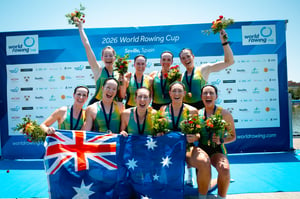
The Australian Rowing Team has opened its 2026 campaign in sensational fashion, with the Women’s Eight winning the Gold Medal at World Cup I in Seville, Spain.
In a commanding performance in Sunday’s A-Final, the crew led for much of the race to claim Australia's first women's international A-Final victory of the new Olympic cycle.
The highlight of the final day for Australia was the win by Australia’s Women’s Eight. But Australia also won the Silver Medal in the Women’s Four A-Final, and the Women’s Pair of Katherine Easton and Emmie Frederico placed fifth in their A-Final.
Australia also shone in the two B-Finals it was represented in on Sunday. Tara Rigney OLY won the B-Final of the Women’s Single Sculls for a 7th place ranking in what was her first international regatta since her fourth at the 2024 Paris Olympics.
Australia also placed second in the B-Final of the Women’s Quadruple Sculls for an 8th place ranking in their debut international regatta together as a crew.
It was an impressive display by the Australian Women’s team, in its first regatta since leaving left the cool climate of Australia for the heat of Europe on May 21.
The results in Seville where Australia was only represented by the Women’s Team, were also a positive reflection of Rowing Australia’s high-performance program that is underpinned by more than a decade of support from Hancock Prospecting and enduring commitment of Rowing Australia Patron Mrs Gina Rinehart AO. From trials to crew selection, and now the big stage of international competition, Hancock Prospecting’s investment plays a pivotal role in enabling Australian crews to prepare, perform and succeed against the world’s best in events like the World Cup regattas. The women's performances in Seville are a result of their preparation at the Hancock Prospecting National Training Centre on the banks of the Nepean River at Penrith, NSW.
RA also acknowledges the support of the Australian Institute of Sport (AIS), Australian Sports Commission (ASC), and Australian Government, whose investment enables athletes, coaches and programs to perform on the world stage.
"The women's team have shown both their class and potential here in Seville,” RA Performance Director Paul Thompson said.
“The Eight and Four are fighting at the front of the field, the Pair is in the A Final, Tara has improved with each race as she comes back from a break and the youngsters in the quad were competitive.
“The racing always gets tighter as the season progresses and the women can prepare for that with confidence from what they achieved in Seville.”
A-Finals
In the Women’s Eight, the Australian crew of Georgie Gleeson (bow), Eliza Gaffney (2), Lily Triggs OLY (3), Ella Bramwell (4), Samantha Morton (5), Paige Barr OLY (6), Jaime Ford (7), Laura Gourley OLY (s) and Hayley Verbunt OLY (coxswain) raced their Semi-Final in Lane 4, had a terrific start and were second at 500m, 0.62 behind Romania.
However, the Ellen Randell-coached Australians, who were third in Friday’s Preliminary race to determine the lane draw, powered on to take the lead by 750m.
“We were just thinking, ‘hit the start hard, try get into a rhythm, emulate or wind …’ I'd say we executed pretty well,” Samantha Morton, the 5 Seat, told Worldrowing.com.
At 1000m, Australia was still just in front, by 0.16 over Netherlands in second place and 0.58 on third placed Great Britain who are coached by Randell’s brother, Andy.
As tight as the race was, Australia responded to the pressure of an expected challenge from their opposition superbly. Instead of waiting for it, Australia unleashed a major effort in the third 500m under the call from coxswain Hayley Verbunt to extend their lead by 1500 to 0.84 over Netherlands and 1.08 over Great Britain.
As Paige Barr, the 6 Seat, told Worldrowing.com of their approach to the second 1000 metres: “In the ‘prelim,’ we did have a good second ‘K.’
“So, we wanted to really make the most of that and hit it even harder, and I think we did a pretty good job of that.
Australia’s reward for their calm, control and courage was a terrific win (6:08.35) over Netherlands (6:09.76) in second and Great Britain (6:10.25), in third. Romania (6:12.20) and Germany (6:20.71) followed in fourth and fifth places respectively.
For the Australian Eight it was the best start to the international season.
“This is a new crew, some fresh faces. We're working at the chemistry, but it's clicking well, and this is massive confidence in the bank for what's to come,” said Morton.
For Barr, even better … Sunday was her birthday!
“A very good way to celebrate my birthday,” she said. “Huge day. Best birthday ever. It's great to do it with the girls.”
In the Women’s Four, Australia won the Silver Medal in their A-Final in a magnificent tussle with Netherlands who had to fight from behind to take the lead in the third 500m to win.
Racing in Lane 4, the crew of Georgia Patten OLY (bow), Bronwyn Cox OLY (2), Jacqueline Swick OLY, and Georgie Rowe OLY (stroke) out from the start.
But it was clear their Dutch opponents would be up for the challenge as the gap between the two crews was 0.70 at 500m and 0.16 at 1000m in Australia’s favour.
It was in the third 500m that Netherlands threw the gauntlet down to take the lead from the James Harris-coached Australians. With 1250m raced, Netherlands just managed to edge their bow in front, and at 1500m the gap between them was 0.73. Meanwhile, New Zealand were the best of the rest to be third at 4.08s to the two leaders.
However, while the Dutch had impressively asserted themselves, by no means did Australia capitulate. As Australia’s rate rose to 40 strokes per minute, the gap between them and Netherlands narrowed with every stroke, and suddenly the Dutch found themselves having to respond and increase their rate to 44 strokes per minute.
Crossing the finish, the gap between the Gold Medal winners, Netherlands (6:34.92) and second placed Silver Medallists Australia (6:35.45) was a canvass – or 0.53. Meanwhile, New Zealand (6:43.24) finished in third place to take the Bronze Medal.
In the Women’s Pair, the new-look Australian crew of Emmie Frederico (bow) and Katherine Easton (stroke), racing in Lane 1, placed fifth in their A-Final.
After a false start by Romania in Lane 6, the race was re-started; but the delay did not deter the early pace setters: Czechia, France and Chile.
The Czechia crew of Anna Santruckova and Pavlina Flamikova got away best, followed by Chile’s Antonia and Melita Abraham and French World Championship Silver Medallists Emma Cornelis and Hezekia Peron.
At 500m Czechia still led the race from Chile, France and Lithuania. The Xavier Dorfman coached Australians were in fifth place and 2.31 down.
The race up front was a see-saw thriller. By 1000m, France had taken the lead from Czechia, followed by Chile and Lithuania, while Australia was still fifth.
At 1500m France still led, but by then Czechia had pushed back into second ahead of Chile and Lithuania, while Australia was still fifth but now at 5.18.
In the last 500m, Czechia stormed through to just win (7:10.26) from France (7:10.94,). Chile (7:12.64) fended off a charge by Lithuania (7:13.39) for third, leaving Australia in fifth (7:18.77) and Romania (7:28.95) sixth.
B-Finals
In the Women’s Single Sculls, former Gina Rinehart AO Leadership Award recipient and two-time Olympian, Tara Rigney, won the B-Final well for a 7th place ranking in her first international regatta since her fourth place finish at the 2024 Paris Olympics.
Rigney, racing in Lane 4, took the lead in the third 500m, passing the Swiss Under-23 world champion Aurelia-Maxima Janzen who had led from the start.
Until her winning push, Rigney was close to Janzen. At 1000m, Rigney was only 0.66 behind Janzen, while in third place was Belgium’s Mazarine Guilbert at 2.54.
Once Rigney, coached by Alfie Young, took the lead she surged away from Janzen to win comfortably (7:44.61). In second place was Guilbert (7:45.84) after a mighty last 250m effort to move up a place ahead of Janzen (7.47.87) who finished third.
In the Women’s Quadruple Sculls, the Jamie McDonald coached Australians placed second in the B-Final for an 8th place ranking in their debut regatta together.
Racing from Lane 3, Romy Cantwell (bow), Emily Sheppard (2), Sara de Uray (3) and Sarah Fahd (stroke) did not shy from dictating affairs and lead up to 1000m.
France then responded by taking the lead in the third 500m. At 1500m, the French led the race by 1.84s over Australia, 4.40s over Netherlands and 6.55s over Poland.
France went on to win (6:38.29) from the Australians (6:42.74) who finished second, while Netherlands (6:45.28) placed third and Poland (6:46.31) fourth.
HOW TO CATCH UP ON 2026 WORLD CUP I – Seville: June 5-7
Follow the action across Rowing Australia’s social channels.
For all information on World Cup 1 including results and upcoming events go to the World Rowing website
WHAT’S UP NEXT FOR THE ROWSELLAS
Australian Rowing Team departures to Europe
• June 6 – Men’s Team to Milan, Italy
• June 17 – Australia A Team to Amsterdam, Netherlands
Australian Rowing Team 2026 international calendar
• June 5-7 – Filippi Lido Beach Sprint Regatta: Tuscany (Beach Sprint)
• June 20-21 – Holland Beker Regatta: Netherlands (Men's Pair + Australia A)
• June 27-28 – World Cup III: Lucerne, Switzerland (Women, Men, Australia A, Para)
• August 24-30 – World Championships: Amsterdam, Netherlands
The Australian Senior and Para World Cup team is:
The Australia A Team for the Holland Beker Regatta and World Cup III is:
The Australian Beach Sprint Team for Filippi Lido Beach Sprint Regatta is:
By Rupert Guinness, Australian Rowing Teams Media Manager
Photo credit: Benedict Tufnell/Row360